
I help people tell the real story
of their life, career, or company
In your own words
The best autobiographies and company histories get to the essence of the person or culture. They sound real, because they are. Not a polished, sanitised version of the story but one that rings true to anyone who knows them.
That’s the only kind of book worth writing. And worth reading.
Recently, a client sent the final draft of his book to a close friend. The friend wrote back:
“I was totally captivated by your book. The thing I liked most about it is that it’s in all your own words. It’s the way you speak. It’s you to a tee.”
That’s what I aim for, every time.
Working with a ghostwriter doesn’t mean handing over responsibility for your story to someone else. It means you get to decide what stays in and what stays out. You don’t have to share all of the skeletons in your closet, but you do get to tell the real story, with the rough edges and the awkward moments. The people who shaped you, good and bad.
It’s your story.
It’s your book.
My job is to make it as good as it can be.

What's my story?
When I was 13, my mother gave me a typewriter.
An unusual present for a teenager you might think. I know I certainly did.
But in hindsight, it wasn’t just a present. It was a nudge, a hint, a clue my mother left on my bedroom desk.
That old, yellow typewriter helped me join the dots between my love for reading and the manual, physical act of creating the words, sentences and paragraphs that made up the stories I surrounded myself with growing up.
My mother recognised my love for stories was something worth nurturing, that it could lead somewhere. Not me.
Like many young fellas I dreamed of playing sport for a living when I grew up.
But around the same time my Mum gave me the typewriter, I slowly started to accept I wasn’t the best player on my street. And I clearly wasn’t good enough to play any sport professionally. But I thought maybe, just maybe I could write about sport instead.
I taught myself how to touch type on the typewriter my mother gave me, a skill that came in handy when I got a summer job at the local newspaper. I also volunteered as the Sports Editor for my school magazine. And I was committed to a career as a writer, or at least as committed as any 17-year-old can be.
Then I went to university to study English & Politics where I got distracted by Cigarettes & Alcohol. In college, I came to associate writing with lectures and exams and gave up on my dreams of being a journalist. After I graduated from university I spent a few aimless years working in sales, insurance and recruitment, all the time ignoring this gut feeling I should be writing.
Every Sunday I got this knot in my stomach that got worse as the day went on. It was the Sunday terrors, that horrible dread of going back to work on a Monday morning to a job I hated. The Lost Years as I call them now were tough at the time but they were also some of the most important and formative years of my life.
In my late 20’s, I finally listened to my gut and quit my job as a recruitment consultant to become a freelance writer.
I convinced the editor of my local paper to give me a shot as a rookie Sports Reporter. I didn’t have any experience or qualifications. But I could touch type and I knew a lot about sports. That was enough.
Since then I’ve worked as an award-winning freelance journalist for various newspapers and magazines including: ESPN.com, Metro, New Zealand Geographic, Sky Sport The Magazine, Herald on Sunday, and the Sunday Star Times. I also spent five years working with Red Bull as the NZ editor of their global magazine, The Red Bulletin.
I wrote my first book in 2016 and since then I’ve written seven books for founders, owners, companies and family businesses.
Write. Run. Repeat.
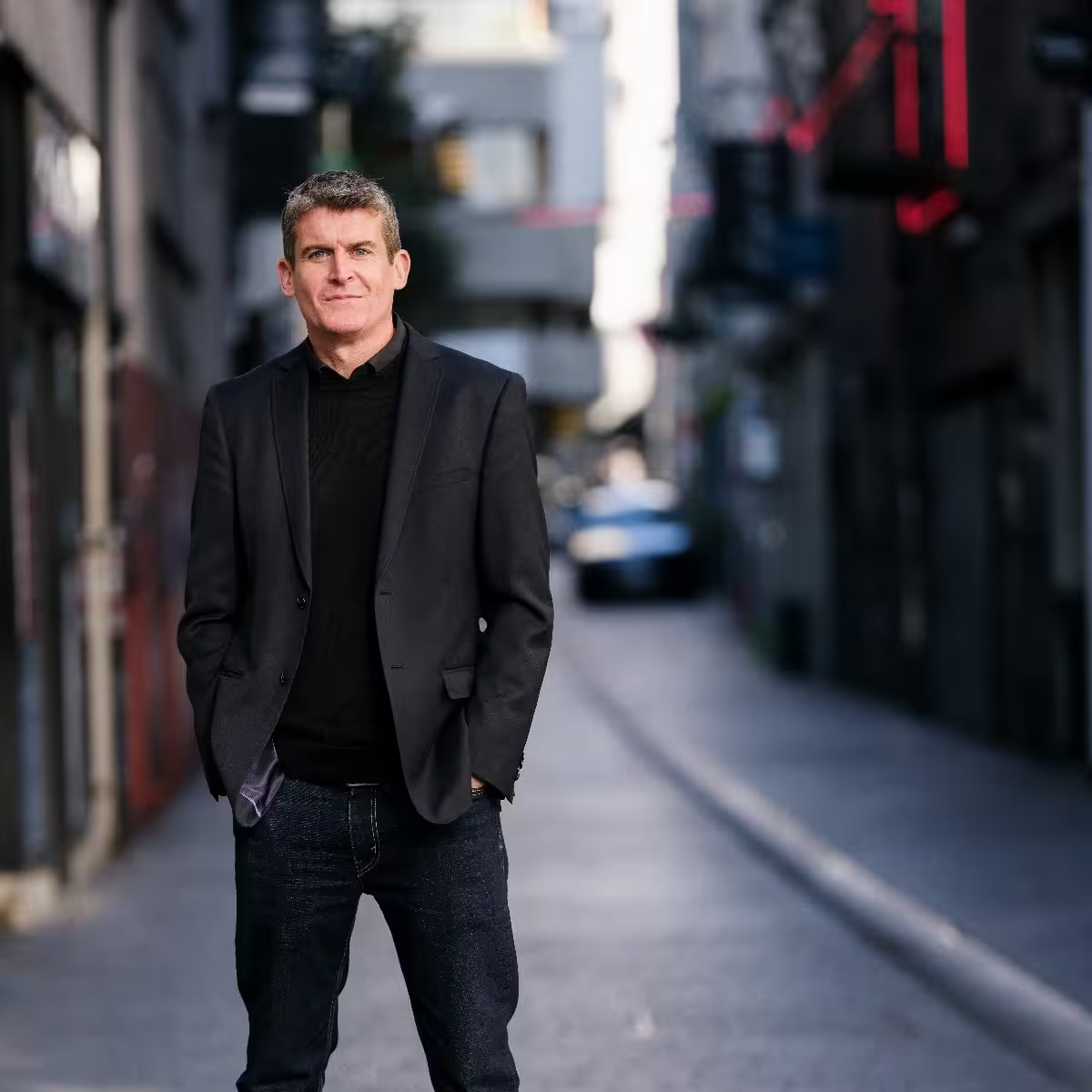
Robert Tighe is a ghostwriter based in Auckland, New Zealand, working with founders, owners and family businesses across New Zealand, Ireland, Australia and the US.
I’m a proud Irishman but I moved to New Zealand in 2004 and I feel lucky to call this beautiful part of the world home. I also feel lucky to have worked with ghostwriting clients all over the world.
My surname is pronounced ‘Tie’ not ‘Tig-He’ but most people call me Rob.
When I’m not writing or chasing after my three crazy kids, I’m proud to call myself a running fool and I love exploring the hills and forests of Aotearoa to run long-distance trail races.
I ran my first road marathon in Iceland in 2003 and since then I’ve competed in lots of trail running events in New Zealand, including 100 kilometres at the Taupo Ultra.
The next step you take isn’t a commitment. It’s a conversation about the book you think you might have in you, who it’s for, and whether I’m the right person to write it for you. No pitch. No pressure.
If you want to try before you buy, then ask me about the ‘test drive’ option.

Frequently Asked Questions
Don’t see your question here? Feel free to get in touch for a chat.
What is a ghostwriter?
A ghostwriter is a professional writer who writes a book on behalf of someone else, in that person’s voice. The book is published under the client’s name, with the ghostwriter’s name usually appearing quietly in the acknowledgments or a closing note at the end. It’s the standard practice behind most well-known founder, celebrity and business memoirs — Andre Agassi’s Open, Prince Harry’s Spare and Lee Iacocca’s autobiography were all ghostwritten.
Will it sound like I wrote it?
My job is to let your voice shine on the page. The test is whether the people who know you best read it and hear you. It starts with a lot of listening. Over a series of long, recorded conversations, I pay close attention to how you speak, the words you use, the ones you’d never use, and the way you tell a story. If necessary, I also interview other people for the story. Different voices help to add colour, context and perspective to the book.
If you would prefer a more conventional, third-person narrative, I can do that as well.
I don't want it to be all about me. Is that okay?
Yes and most of my clients say the same thing. A good founder or company book doesn’t have to be a vanity project. It can be a record of the people who built the business, the deals that defined it, and the culture that made it worth working at. The founder’s story is a thread through the book, not the whole book.
How long does it take to write a book with a ghostwriter?
A serious book takes anywhere from six to ten months from the first conversation to the final page. Most of that time is mine, not yours. You show up for the conversations and I do the research, listening, writing and editing. I usually only work on one project at a time so the book gets the attention it deserves.
How does the process actually work?
We meet regularly, usually a video call or face-to-face chat 2-4 times a month for an hour or two. You talk, I listen and ask questions when I need more detail. Between calls I turn the conversations into chapters, which we review together and shape over multiple drafts until the book reads the way you sound.
Do I have to do any writing myself?
No, not unless you have already or really want to. Almost all of the writing is mine. Your job is to show up for the conversations, tell your stories, and give feedback on the drafts. If you’d rather write parts yourself that’s fine too — but most clients find it a relief to hand over the writing to an expert.
Do you work with clients outside New Zealand?
Yes. I’ve written books for clients in New Zealand, Ireland and Australia, and I’ve done most of that work over video calls. Distance isn’t a barrier. A fortnightly Teams call works just as well from Dublin as it does from Dunedin, and I can travel for the parts of a project that need it.
Who owns the book?
You do. The book is published under your name and you own all the rights, including the copyright. My name usually appears in the acknowledgments or a short closing note at the end of the book, at your discretion. If you want to give me a credit on the front cover, that would be much appreciated. But it’s your book and your call.
How much does it cost to write a book with a ghostwritter?
Every project is different so I quote per project rather than by the word or the hour. A full-length book is a serious investment and I’m happy to talk numbers on an initial call once I understand the scope of what you have in mind.
What books have you written?
Recent projects include Ion Man: The Life & Adventures of Bill Buckley (2024), Zero to 60 and Beyond with motorsport entrepreneur Tony Quinn (2016), and Highlands: If You Build It, They Will Come, a company history for a New Zealand tourism and recreation business. Current projects include a life story for an Irish entrepreneur and a company history to celebrate the 60th anniversary of an iconic New Zealand company.
What if I've already tried writing the book myself and got stuck?
That’s common. A lot of my clients have started, written a chapter or two, and hit a wall, usually because there’s too much material and no clear thread. Part of my job is helping you find the shape of the book, then doing the heavy lifting from there. It doesn’t matter whether you’re starting from scratch or from a stack of half-finished drafts.
Can you help me publish the book?
I can, but I’m honest with clients about what publishing actually looks like right now. The mainstream publishing world is tough. Most publishers only take on authors who already have a significant audience or platform. Self-publishing works well for founder stories, life stories and company histories, and is what most of my clients end up doing. You will have to factor in the cost of production and marketing on top of the writing itself.
I work with an experienced publisher, book designer, editor and proofreader to make sure the finished product is as good, if not better, than anything you could get from a mainstream publisher. And if you want to see your book in bookshops, I can help with that too.
Who is Robert Tighe?
Robert Tighe (pronounced Tie, not Tig-he) is a ghostwriter based in Auckland, New Zealand, who writes books for founders, business owners, companies and family businesses across New Zealand, Ireland and Australia. His work covers memoirs, autobiographies, life stories and company histories. He’s been writing books with clients since 2016, following a fifteen-year career as a sports journalist writing for ESPN, Red Bull and most of New Zealand’s leading newspapers and magazines.